click this link to see the soloists’ biographies
Below are the programme notes for the concert
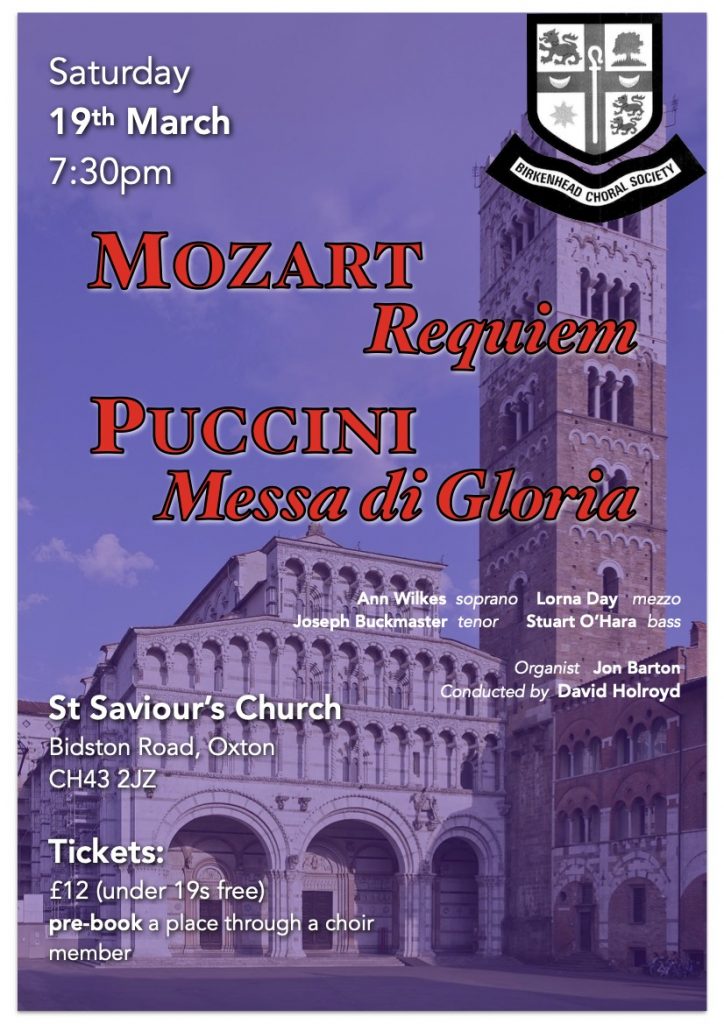
Mozart Requiem
The story behind Mozart’s Requiem of 1791 has been made famous (if not historically accurately so) by the film Amadeus. Certainly he received a commission to write a Mass for the Dead. The film has Mozart haunted by the ghost of his estranged father; ascribes the commission to the rival Viennese composer, Salieri; and shows that Salieri planned to pass off the greatest Requiem ever written as his own work, once he had obtained it from Mozart, and murdered him. In fact the commission was from one Count Walsegg
Mozart certainly left the work incomplete – the last notes he composed are those in bar 8 of the Lachrymosa. But the sketches he left, and with what his pupil, Süssmayer, knew of his plans, and the gaps which he himself filled in, it was possible to provide a completed Requiem for Count Walsegg, in order for Constanze, Mozart’s widow, to collect the fee.
No-one knows exactly what happened. But does it really matter when the music itself is so sublime?
Scholars know what Mozart definitely wrote down, suspect what he sketched, and conjecture upon what they can’t prove. To my mind (and this is of course subjective), the only parts of the work which do not seem to carry the “feel” of Mozart are the Sanctus, and the Osanna to the Benedictus. Just how much of the rest he completed, dictated, sketched or suggested we shall never know; but those two sections apart, it has an indescribable something, which just seems uniquely like Mozart. There have been several modern attempts at completing/reconstructing the piece, but I think the well-accepted version by Süssmayer respects Mozart’s intentions; and he is the only one to have direct contact with Mozart, which must lend significant authority to his work.
Puccini – Messa di Gloria
Puccini’s Messa a quattro voici is a full mass, consisting of the six movements forming the Ordinary of the Mass (Kyrie, Gloria, Credo, Sanctus, Benedictus and Agnus Dei). Although now generally known by the name Messa di Gloria, this is strictly speaking inaccurate, because a Messe di Gloria contains only the first two movements.
Giacomo Puccini was in the fourth generation of a family of church musicians from Lucca, Tuscany. He held the post of town organist and maestro di capella at the Cathedral of San Paolino. He studied at the Instituto Musicale. In 1876 he had walked from Lucca to Pisa to hear Verdi’s Aida which was the experience that eventually made him decide to follow a career in the theatre rather than the church. He later said that he felt “that a musical window had opened for me”. The mass was composed as his graduation assignment from the Instituto, and was first performed on 12th July 1880, although the Credo had previously been written and performed in 1878 – originally as a self-contained piece. There are more than a few glimpses of the melodic, poignant and dramatic music to come from him, and much of the Mass (apart from its text that is) would have been at home in the opera house. Indeed, Puccini re-used some of his musical material in other works – the Agnus Dei, for example, finding its way into Manon Lescaut.
As apparently liturgical in origin, there are precedents for such an operatic treatment of sacred texts: Rossini’s Stabat Mater and Petite Messe Solonelle of 1832 and 1863 respectively, and of course Verdi’s Requiem of 1874. The Messa di Gloria is a remarkably mature work from an eighteen-year old Puccini, with so much rhythmic vitality, harmonic (and orchestral) colour, and a few little imaginative musical surprises along the way too.
Puccini did not publish the manuscript of the Mass, probably because he was more concerned with turning his attention to composing those operas for which he became so famous.
Given that this is a concert, rather than a liturgical performance, we have reordered the movements, placing the whole of the lengthy Gloria section after the Agnus Dei, so that the evening finishes with the fantastic unrestrained boisterousness of the cum sancto spiritu where the traditional fugal material is combined with the opening melody to bring the whole concert to a lively conclusion.